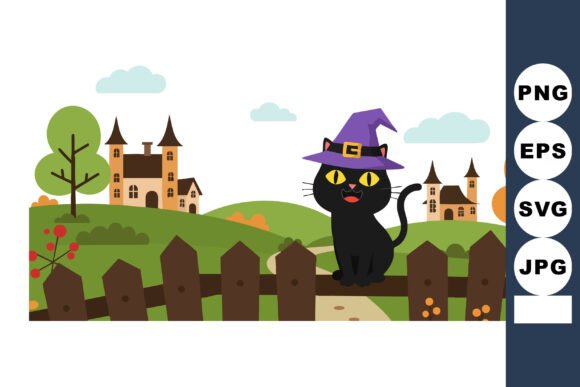
Black Cat Wearing Witch Hat on Fence
A Spooky, Stitch-Ready Illustration—But Not for Every Project
As someone who’s stitched hundreds of Halloween-themed designs across sweatshirts, baby onesies, and boutique tote bags, my first impression of Black Cat Wearing Witch Hat on Fence was immediate: it’s charming, atmospheric, and unmistakably seasonal—but it’s not a plug-and-play embroidery file. It’s an illustration first, a machine embroidery design second. That distinction matters.
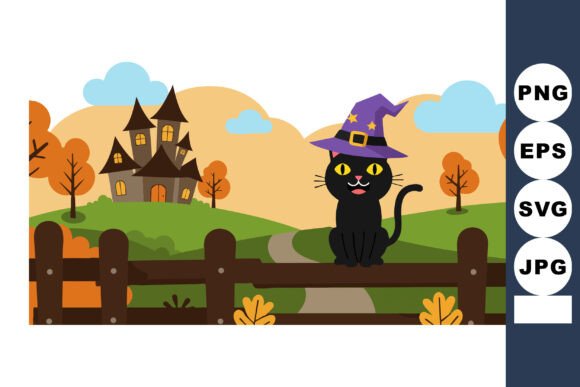
The mood lands perfectly: mischievous but not scary, nostalgic but not dated. The black cat perched on the fence anchors the composition, while the purple witch hat adds just enough pop against autumn trees and a softly rendered haunted house. It reads as cohesive at a glance—ideal for a finished product that needs to tell a story in under three seconds. But when I imagine stitching it onto a medium-weight cotton tote bag (my go-to test piece), I immediately scan for trouble spots: the cat’s ears, the hat’s brim, the fence slats, and those delicate tree branches.
Where This Design Shines—And Where It Needs Caution
Shines on:
- Medium-to-large hoop projects: Think 5x7" or bigger. The background elements give it presence on sweatshirt backs, pillow covers, and tea towels—especially when centered or used as a focal panel.
- Stable, midweight fabrics: Cotton twill, canvas, linen blends, and quilting cotton hold the detail well. I’d confidently use it for an embroidered apron for a local bakery’s Halloween pop-up or a custom baby blanket with gentle satin-stitched accents.
- Personalized gifts and small shop merchandise: It’s got strong giftability—think “spooky-but-sweet” for teachers, pet lovers, or cottagecore shoppers. As an Etsy seller, I’d pair it with a printable mockup showing it stitched on a heather-gray crewneck; that contrast makes the purple hat and black cat pop without needing neon thread.
- Digital product previews: The included SVG and PNG files are crisp and scalable—great for clean website thumbnails, social media banners, or digital lookbooks. The JPG works fine for quick client proofs, but the SVG is your best friend for resizing without pixelation.
Use carefully on:
- Small hoops or tight curves: The fence and house details compress poorly below 4x4". On a cap front or baby beanie, key shapes blur—those tiny windows in the haunted house vanish, and the cat’s tail loses definition.
- Stretchy or textured fabrics: Knits like jersey or terry cloth demand heavier stabilizer and slower stitch speeds. Without that, the fill stitches in the cat’s body may pucker, and the running-stitch fence lines could skip or distort.
- Dark or heavily patterned backgrounds: The illustration relies on contrast—the purple hat against black fur, the fence against muted trees. On black fabric, you’ll need careful thread color planning (e.g., metallic silver for the hat trim) and possibly simplified layering to avoid visual noise.
- Frequent-wash items: While the design itself isn’t overly dense, the background trees and house add cumulative stitch count. For baby clothes or kitchen towels, I’d audit the fill stitch density before stitching—tighter fills hold up better, but too much density stiffens the fabric.
Real-World Test: A Custom Embroidered Tote for a Local Craft Fair
Last month, I prepped Black Cat Wearing Witch Hat on Fence for a limited-run batch of canvas totes sold at a fall craft fair. My goal was handmade charm—not machine-perfect sterility. So I tested three versions: one with standard poly thread on natural canvas, one with matte cotton thread on oat-colored linen, and one simplified (removing distant tree branches) for a 4x4" hoop on a mini pouch.
The full version worked beautifully on the tote—customers loved the storytelling. One buyer said, “It feels like a page from a vintage storybook.” But the mini pouch version? Too busy. The fence blurred into abstraction. Lesson learned: this design earns its space. Respect its scale.
Design Integrity Meets Customer Trust
When your customers pay for a handmade product, they’re buying intention—not just thread and fabric. Black Cat Wearing Witch Hat on Fence supports that intention when used thoughtfully. Its balanced layout and clear focal point make finished items feel curated, not generic. That builds trust, especially for Etsy sellers or small shop owners whose branding hinges on consistency and personality.
But here’s what I watch closely: over-detailing. That haunted house has charm, but if stitched at 3x3", it becomes a muddy blob. That undermines professionalism—even if the customer doesn’t know why, they’ll sense something’s “off.” Clarity > cuteness every time.
Practical Notes Every Embroidery Designer Should Run Through
Before committing thread and time:
- Test on scrap fabric first—same weight and weave as your final piece.
- Check thread color contrast on both light and dark backgrounds. Purple thread on black fabric? Might disappear. Try violet-gray instead.
- Review stitch density in your embroidery software. If fill areas exceed 18–20% density, consider simplifying or adjusting underlay.
- Confirm hoop size compatibility—don’t assume it fits your smallest hoop without measuring.
- Inspect small details at 200% zoom: fence slats, cat whiskers, hat folds. If they’re under 0.5mm wide in the vector, they’ll likely vanish in stitching.
- Test in black-and-white mockups—this reveals value contrast issues faster than color.
- Use proper stabilizer: tear-away for stable wovens, cut-away for knits or lightweight fabrics.
- Verify licensing before selling finished items or bundling the digital embroidery file. Since it’s categorized as Illustrations and Graphics, confirm whether commercial use is permitted—and whether resale of stitched products requires attribution or limits.
In short: Black Cat Wearing Witch Hat on Fence is a strong, mood-driven asset for craft businesses and embroidery designers who value narrative and seasonality. It’s not lazy-decorative—it asks for thoughtful placement, smart prep, and respect for scale. Used well, it elevates a simple tote into a keepsake. Used hastily, it flattens into clutter. Your call—and your needle—make the difference.